
How to Develop Attentiveness in Your Children
/So, let's talk about attention.
"But, Erin," you say, "all your kids have ADHD, and so do you. How are you talking to me about attention right now?"
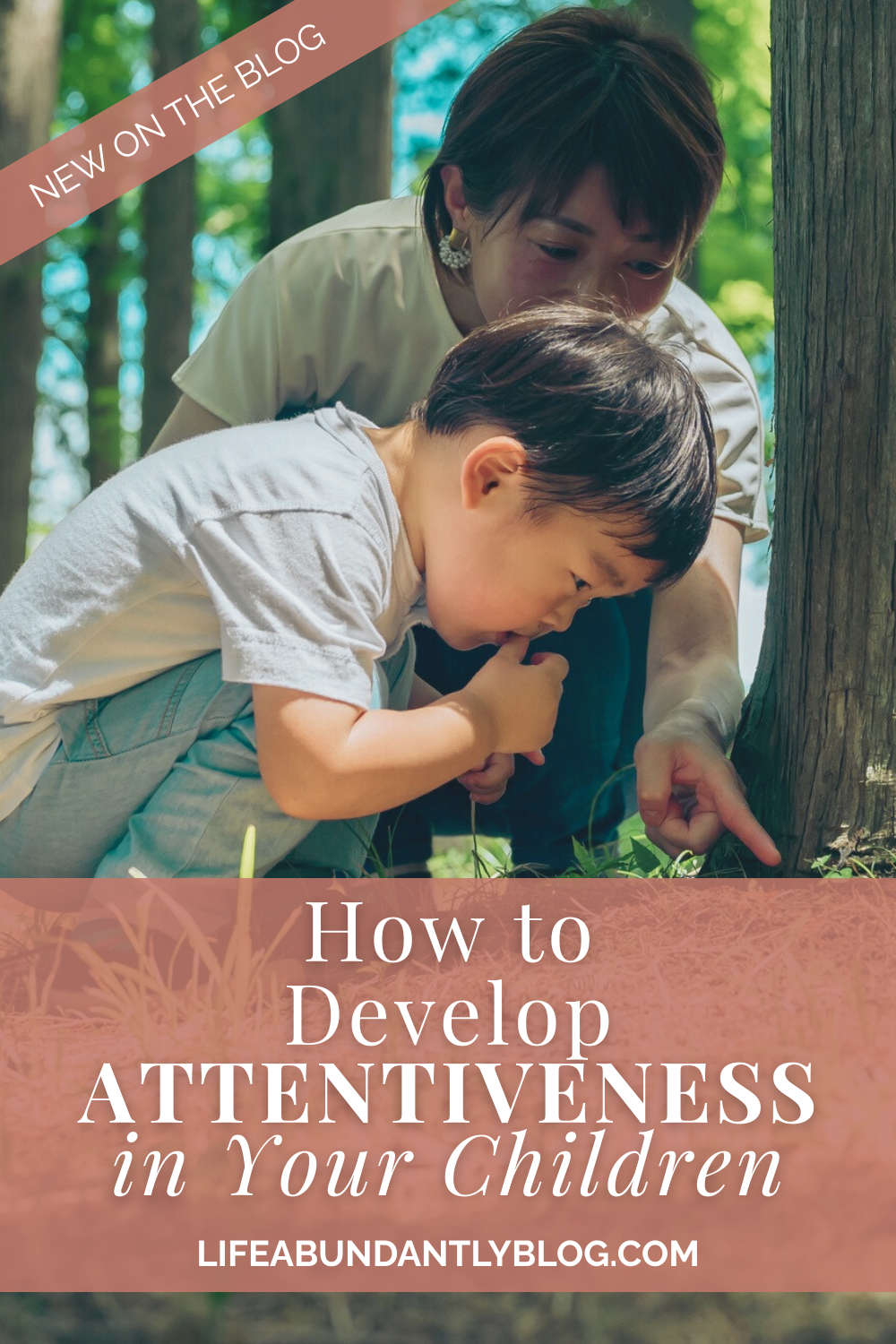
Valid question, friend. And it's exactly because our family struggles with attentiveness that I’ve made it my personal mission to understand how to foster it. When you start out with “attention muscles” that are underdeveloped, being intentional about training those habits becomes even more important.
Charlotte Mason once wrote:
“The highest intellectual gifts depend for their value upon the measure in which their owner has cultivated the habit of attention." (Home Education, Vol. 1, p. 137)
Attention isn’t something that simply springs up in a child. Some children are naturally more attentive than others, but no one comes fully trained. Like perseverance or obedience, attention is a skill and habit—one that must be shaped over time through gentle, consistent practice.
Many of us picture attentiveness as stillness: a child sitting perfectly upright, eyes focused, pencil poised. But that image is incomplete. For most of us, it was shaped by institutional education, not lived experience.
True attention is deeper. It is the inward discipline of turning the heart and mind toward one thing at a time—of shutting out distractions and fastening ourselves to what is in front of us. Attention, in that sense, functions like a muscle. And muscles grow through repeated use.
Today I want to share three practical ways to begin cultivating attentiveness in your children. Each approach starts with the assumption that attention is a skill to be nurtured, not a trait that appears on its own.
1. Build Attention Spans Slowly and Incrementally
One of the most effective ways to grow the habit of attention is by respecting your child’s natural developmental limits. A helpful rule of thumb is this: expect about one minute of focused attention per year of your child's age.
That means:
A six-year-old may attend for 6–12 minutes.
A seven-year-old, 7–15 minutes.
Around age 10, most children can focus for 20 minutes before needing a break.
So if your first grader listens to a story for 10 minutes or finishes a short math practice with real focus, that is a meaningful success. We don’t expect a six-year-old to run a marathon. Likewise, we shouldn’t expect them to sustain focused attention for an hour.
As attention grows, we can gently stretch it. Start with what your child can handle and add just one more minute. When they can complete six minutes cheerfully, encourage them to try seven. Then eight. Use language that helps them feel empowered: invite them to “flex their attention muscle.” And always follow that with a break, a reset, or a shift—which brings us to the next point.
Charlotte Mason advocated for short lessons, especially in the early years:
“Never let the child dawdle over a copy-book or sum, sit dreaming with his book before him. When a child grows stupid (silly or distracted) over a lesson, it is time to put it away… Let him do another lesson as unlike the last as possible, and then go back with freshened wits.” (Home Education, Vol. 1, p. 141)
This wisdom still holds. We must guard against letting the habit of inattention grow, because like attentiveness, it can be practiced too.
Celebrate even short moments of true focus. Those few minutes, repeated and lengthened with intention, will become the foundation of deeper learning.
2. Vary the Type of Work: A Change is as Good as a Rest
The second way to cultivate attentiveness is to alternate between different kinds of mental and physical activity. Minds grow weary when asked to perform the same task too long—especially young minds.
Instead of expecting 30 minutes of silent reading, try 10 minutes of reading, followed by five minutes of movement, then 10 minutes of recitation, and 15 minutes of journaling. You can return to reading later when their mind is refreshed.
Charlotte Mason structured her mornings around many short, varied lessons. Children might study a picture, then recite a poem, then solve math problems, then hear a historical story. These transitions refresh the child’s focus without removing them from learning.
This approach doesn’t result in shallow learning. It trains children to give their full attention to one thing at a time. And that ability—to fully engage, and then shift focus with intention—is a vital life skill.
Narration supports this, too. If your child struggles to narrate more than a sentence or two, shorten the reading until they can attend to the whole. Start with a paragraph. When they can narrate that, try two. As attention strengthens, expand the reading.
In planning your homeschool day, think not only about time spent, but the kind of attention each task requires. Alternate between listening, speaking, moving, and writing. Let the mind rest in one mode while working in another.
3. Use Nature Study to Exercise the Eye, the Hand, and the Mind
One of the richest ways to develop attentiveness is through nature study.
Close observation is demanded in the natural world. To tell a crow from a raven, a child must note feather shape and voice. To distinguish an oak from a chestnut leaf, they must study edges, lobe count, and shape. To sketch a flower or identify a bird call, they must become still and quiet enough to truly observe.
Sketching strengthens what the eye sees. Naming a thing strengthens what the mind remembers. Observation becomes knowledge when it is engaged through the senses and practiced regularly.
Charlotte Mason’s “Formidable Attainments for a Child of Six” include knowing the names of twenty wildflowers, six trees, and six birds. This wasn’t a checklist to rush through—it was a reflection of the attentiveness shaped by regular outdoor time.
When children sketch, narrate, and journal what they see, they are training their powers of attention. But they are also developing a deeper love for God’s creation—and cultivating carefulness that carries over into other areas of life.
Bringing It All Together
To nurture the habit of attention, remember these three practices:
Start small and build slowly, adding time as your child’s capacity grows.
Vary the type of work, alternating between mental and physical tasks.
Engage in nature study, training the senses through joyful observation and recording.
Each of these tools supports the habit of attention without pressure or perfection. Together, they offer a clear, manageable approach to strengthening this essential skill.
How Our Curriculum Helps
This is why our Gentle + Classical Nature Volumes and Creation: Agricultural Science are designed with both attainments and unit studies in mind.
The attainments—reciting poetry, naming trees, sketching birds, narrating what’s observed—build the habit of attention.
The unit studies—from forests and oceans to animal husbandry and soil—give children meaningful content in which to apply that habit.
When your child sketches a bird in flight or writes about a maple tree they’ve identified in the yard, they aren’t just doing a nature study assignment. They’re practicing attention. And when attention is trained through delight, it sticks.
These programs are built not just to help you teach, but to help your child see.
Your Next Step
If you're ready to begin strengthening attention through joyful learning, start with one of our creation-focused programs:
Explore Gentle + Classical Nature Vol. 1: Inland Waterways & Forests
Explore Gentle + Classical Nature Vol. 2: Shorelines & Oceans
Each full-year resource gives your family opportunities to observe, sketch, and journal what is already around you.
Attentiveness doesn’t happen by accident. It is sown carefully, watered daily, and grown slowly.
Let’s keep cultivating it together.












I'm so glad you're here! I was just thinking about my last post where I shared our plans for the upcoming school year. Several people had questions about our participation in Classical Conversations and also, "How will you do all of that?" lol.
I wanted to address those questions because I think the answers may be helpful. When you see someone's homeschool plans written out, it's easy to miss all of the context behind how those plans actually fit into a family's week. So, here's a little more context about ours.